
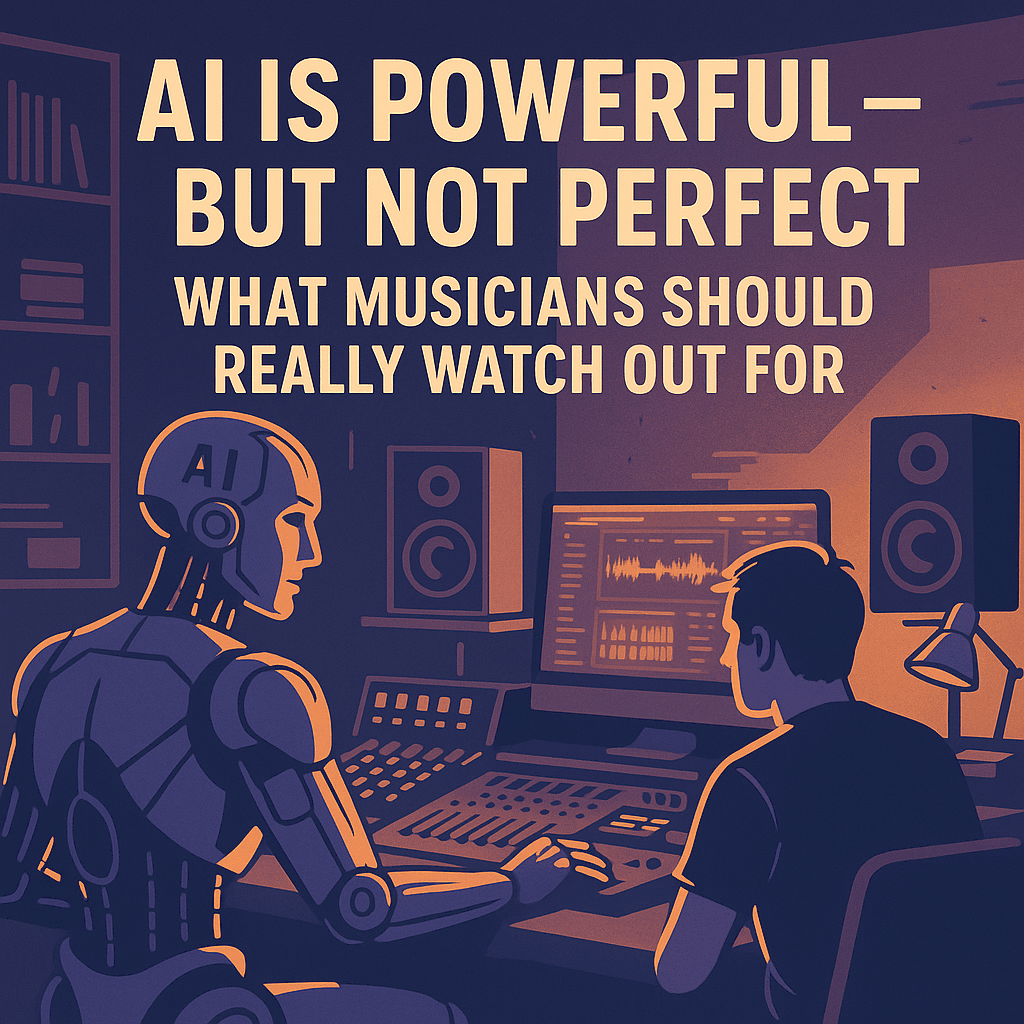
Where AI Really Shines for Musicians
Let’s start with the good news: there are areas where AI can make your life as a musician genuinely easier and more creative, with very little downside—as long as you stay in control.
1. Turning Creative Blocks into Momentum
Staring at a blank session can kill a day. AI is excellent at breaking that stalemate. You can feed it a loose concept and let it spit back lyric fragments, themes, metaphors, or even alternate song titles. None of that has to be “the answer,” but it can get you from zero to “okay, now I’ve got something to react to.”
The same goes for chords and arrangements. Ask for variations on a simple progression, or for ways to reharmonize a chorus, and you’ll often get a couple of ideas you might not have reached on your own—especially when you’re tired or under deadline.
Use AI here for:
- Expanding a half-formed idea into multiple options
- Reframing a song concept from different emotional angles
- Generating possible structures (intro → verse → pre → hook, etc.)
- Exploring “what if we took this into a different genre?” questions
2. Cleaning Up the Technical and Workflow Side
Most musicians don’t get blocked creatively—they get buried in technical friction. Routing, templates, recalling patching, organizing sessions, naming files, figuring out why the phase looks weird on a drum recording… AI is incredibly helpful as a “second brain” for that stuff.
You can ask it to explain what your compressor is doing, how to set up a tracking or mixing template in Pro Tools or Logic, or how to structure your folders so that future-you doesn’t hate present-you. Those are all areas where AI’s broad training and pattern recognition shine.
3. Marketing, Content, and Staying Visible
The modern music grind doesn’t stop at the record. You’re expected to be a content machine, a brand, and a marketer on top of being an artist. AI can dramatically lighten that load without taking away your voice.
You can use it to sketch out a rollout plan for a single, draft an email to your list, generate three variations of a show announcement, or optimize a blog post for search without feeling like you’ve taken on a second job.
Smart AI marketing use cases include:
- Drafting social captions you tweak, not copy-paste blindly
- Turning a studio diary into a polished blog post
- Summarizing streaming and social analytics into “what should I actually do?”
- Helping keep your website or EPK up to date with clean, consistent copy
4. Vocal Production and Pre-Production
AI is starting to play a real role in vocal production—not as a replacement for artists, but as a way to move faster and explore more options. You can use vocal tools to generate harmonies, sketch doubled parts, or create reference vocals that help you hear an arrangement before you pull the singer back in.
In a professional studio context, like at Clear Lake, these tools are most powerful when they’re treated as “assistants.” They help you hear possibilities quickly, then you decide what’s worth chasing in the live room.
Where AI Struggles (And Where You Should Be Skeptical)
For all those strengths, there are hard limits baked into how AI works. Ignoring them can lead to bad advice, weird decisions, or music that feels polished but empty.
1. The Knowledge Cutoff Problem
Every AI model has a point in time where its “education” stops. It doesn’t naturally know what happened after that date. Some systems can browse the web to fill in the gaps, but many answers you get are still coming from a static, older snapshot of the world.
In music, this matters a lot more than people think. Streaming payouts change, social algorithms shift, legal rules around AI and copyright evolve, and new platforms rise and fall quickly. If you ask an AI about “what’s working on TikTok right now” or “the latest Spotify playlist rules,” and it’s drawing from outdated information, you could base a release plan on yesterday’s reality.
The fix is simple: if you’re making a business, legal, or platform decision, make sure the AI is citing current sources or double-check what it gives you against real 2025 information.
2. Confident… and Wrong
One of AI’s weirdest traits is that it doesn’t show doubt the way humans do. It will give you a clean, well-written answer even when it’s guessing or straight-up wrong. That can be dangerous in areas like mixing technique, gear advice, or anything that touches contracts and rights.
You might get a very convincing explanation of a plugin feature that doesn’t exist, or a “best practice” that no working engineer actually uses. When something sounds a little off, that’s your cue to push back, test it in a session, or ask someone with real-world experience.
3. No Lived Experience, No Real Emotional Gravity
AI can describe heartbreak, joy, rage, or hope with impressive language. What it can’t do is actually feel any of it. That gap shows up most clearly in lyrics and melody.
Left to its own devices, AI will often write “correct” lyrics that scan well but don’t say anything specific. They feel generic because they are. When you feed it your story and your details and then rewrite what it gives you, it becomes useful. When you let it write the whole song, it usually sounds like a polished demo for nobody in particular.
The same thing is true in performance. An AI-generated vocal can be eerie and impressive, but it doesn’t replace a real human in front of a mic, in a room, on a day when something actually matters to them.
4. Clueless About Human Politics
The music industry is a web of relationships, subtext, and unspoken rules. AI doesn’t read body language, doesn’t know who’s bluffing, and doesn’t understand that sometimes the safest thing to say in a meeting is nothing.
It can help you rehearse a pitch, or clean up an email to a label or manager. But it can’t tell you if the label is serious about your project, if your co-writer is quietly checking out, or if your bandmate is about to quit. That’s still all you.
5. It Still Doesn’t Replace Trusted Ears in a Great Room
AI can analyze frequency curves, dynamics, LUFS, stereo width, and more. Those are powerful tools. But they aren’t the same thing as feeling a song move air in a real studio, with real monitors, and with a producer or engineer who knows when something is “done” versus just “loud.”
This is why artists still book rooms like Clear Lake. The tech helps, but the combination of a tuned space, world-class gear, and human experience still beats any plug-in preset or AI “mastering” pass.
Legal & Ethical Landmines Around AI in Music
One area where you really want to keep your eyes open is the legal side of AI. The laws are playing catch-up, and the stakes are your voice, your likeness, and your catalog.
Voice models and style-mimicking tools raise real questions: Who owns the result? What happens if someone trains a model on your vocals without permission? Is the beat or topline you got from an AI tool truly “yours” to license?
On top of that, a lot of AI systems train on massive amounts of music they didn’t license in a traditional way. That battle is just getting started in courts.
Practical safety tips:
- Avoid uploading unreleased or sensitive stems into untrusted tools.
- Read the terms of service for any AI platform you rely on.
- Be cautious with vocal cloning—yours or anyone else’s.
- When in doubt, talk to a lawyer before you stake a release on AI-generated material.
The Real Sweet Spot: Artists + AI + Real Studios
None of this is an argument against AI. Used wisely, it gives independent artists an advantage that used to be reserved for big-budget teams: instant assistance, fast drafting, endless iterations, and a way to keep up with the content treadmill without burning out.
But the records that last—the ones people still talk about ten or twenty years later—come from a blend of tools and humanity. A human voice in a great room. A band locked in together. A producer making a call based on instinct, not just meters. Those ingredients still matter, and probably always will.
AI is power. You are the direction.
When you combine:
- Your taste
- Your story
- Your performance
- AI speed and flexibility
- A professional studio environment
…you get something you can’t buy as a preset.
Want to Use AI in Your Music — Without Losing Yourself?
At Clear Lake Recording Studios in Los Angeles, we help artists blend new tools with real-world experience every day. That can mean anything from simple AI-assisted harmonies to fully hybrid analog/digital workflows for albums and Atmos releases.
Some of the ways we can support you:
- AI-assisted vocal harmonies, doubles, and pre-production ideas
- Hybrid analog/digital mixing and mastering workflows
- Dolby Atmos production in a purpose-built room (learn more)
- Analog tape recording on our Studer 827 for a truly human feel (analog tape sessions)
- Guidance on release strategy and content so your music actually reaches people
If you’re ready to experiment with AI but want to keep your sound, your story, and your standards intact, get in touch with Clear Lake Recording. Let’s make something powerful—and human—together.