
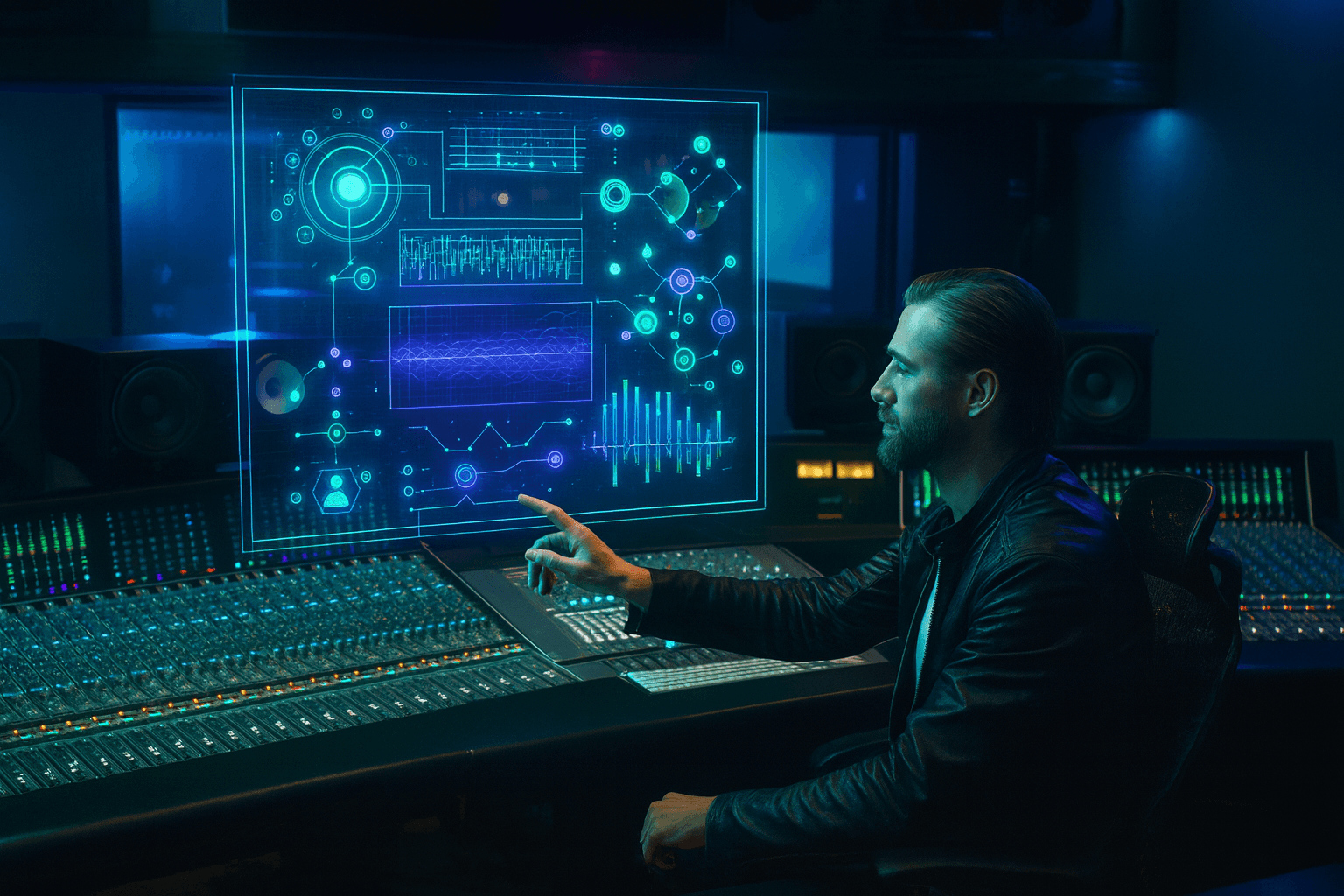
AI music production and AI-generated music. That doesn’t mean musicians disappear. It means the role changes into something that feels a lot more like being a creative director, archivist, and personal brand with a sound-design signature stamped on everything you do.Think of it the way electronic producers reshaped music in the ’80s—except this time it’s the entire relationship between
ideas and sound. The future of music and AI isn’t scary. It’s weird. And weird can be profitable.
A World Where Songs Aren’t Written—They’re Grown
Imagine you can hum a half-formed melody into your phone and instantly hear ten fully produced versions. Want it with a
chopped gospel choir? Bold ’70s horns? A time-bent breakbeat? You don’t “produce” it in the old sense—you
curate, steer, correct, and specify what matters. The AI tool does the grunt work; the musician defines the taste.
In that kind of AI music workflow, the trade isn’t in the labor anymore. It’s in the taste.
People pay you not to make sound, but to decide what’s worth keeping.
Fans Won’t Care Who “Played” It—They’ll Care Who Owns the Aesthetic
In a future where AI in the music industry is standard, artists become identifiable by the way they direct their AI, the texture of their decisions, and the boundaries they refuse to cross. Just like great photographers trained a camera to see the world their way, musicians will train models to
sound like them, think like them, and bend rules the way they bend them.
That becomes the asset. Your sound isn’t just a performance anymore—it’s an ecosystem that can’t be replicated without you.
New Ways Musicians Will Make Money in an AI-Driven Music Industry
So how do you actually get paid in this future? Here’s where the money is likely to move as AI-generated music becomes normal.
1. Signature AI Models as Your “Instrument”
Your personal AI model becomes your new main instrument. Fans, students, and collaborators will
license your sound the same way people license sample packs, loop libraries, or drum kits today.
You’re not just selling songs—you’re selling style as a tool. This might look like:
- Your “Producer Signature Model” people can use to generate ideas in your lane.
- Custom AI voice or vocal-chain models for specific genres.
- Paid tiers for access: hobbyist, pro, commercial licensing.
2. Curation and “Taste Direction” as a Service
Labels, brands, and independent artists will still need someone to make decisions. AI can generate infinite options,
but it still needs a human to say, “That’s the one” and “Here’s how we finish it.”
The bottleneck becomes taste, not talent density. You can charge for:
- AI-assisted production consulting (you help people steer their tools).
- Curating full albums or playlists built on AI-generated stems.
- Creative direction for sync libraries, games, and film scores.
3. Authentic Human Capture Becomes Premium
When everyone has a perfect AI bass player in their laptop, real bass players become a luxury item. Same for drummers, vocalists, string players—anyone who can bring a live, unpredictable, human performance to the table.
Ironically, when everything can be faked perfectly, the real thing feels special. A slightly messy but emotional take might be worth more than a flawless robot performance. Imperfections become collectibles.
4. Live Performance as the Ultimate Flex
If everyone can “generate” music, live performance becomes proof of authenticity. Shows evolve into immersive experiences that blend
AI visuals, spatial audio, and real musicians on stage.
You can monetize:
- Exclusive, one-off shows built around AI-enhanced arrangements.
- Residencies where every night’s set is partially re-generated.
- VIP access to soundcheck, rehearsal, and the behind-the-scenes AI process.
5. Archival Recordings as Long-Term IP
Old sessions, stems, and live recordings become long-term assets. Real rooms, real amps, real vocal chains—these can be
licensed to train models or turned into ultra-realistic emulations.
Studio archives transform from “hard drives in a closet” into a renewable licensing engine in the AI music era.
The Winners Won’t Be the Loudest. They’ll Be the Most Specific.
The people who thrive in this version of the future won’t be the ones posting the most content. They’ll be the ones with a
sound that’s unmistakably theirs—a sonic fingerprint with personality, bias, attitude, and flaws they intentionally keep.
AI erases the middle.
It doesn’t erase the edges.
The future musician is a designer who shapes emotion, builds rules around their taste, and bakes a recognizable advantage into their sound—something people can license, borrow, or collaborate with, but never fully steal.
In the next decade, the successful artist in an AI-powered music landscape will be the one whose style becomes:
- A model others license for their own productions.
- A live experience people can’t replicate at home.
- A catalog of real recordings with value beyond streams.
- A sonic identity that functions like a brand, not just a playlist slot.
This isn’t a machine takeover. It’s a bigger playground for creators who actually have something to say—and the discipline to turn that into a system.
The artists who win aren’t the ones competing with AI.
They’re the ones training it to get weird with them.